Sui Gas Bill Charges Explained: Fixed Charge, GST, Arrears & Meter Rent
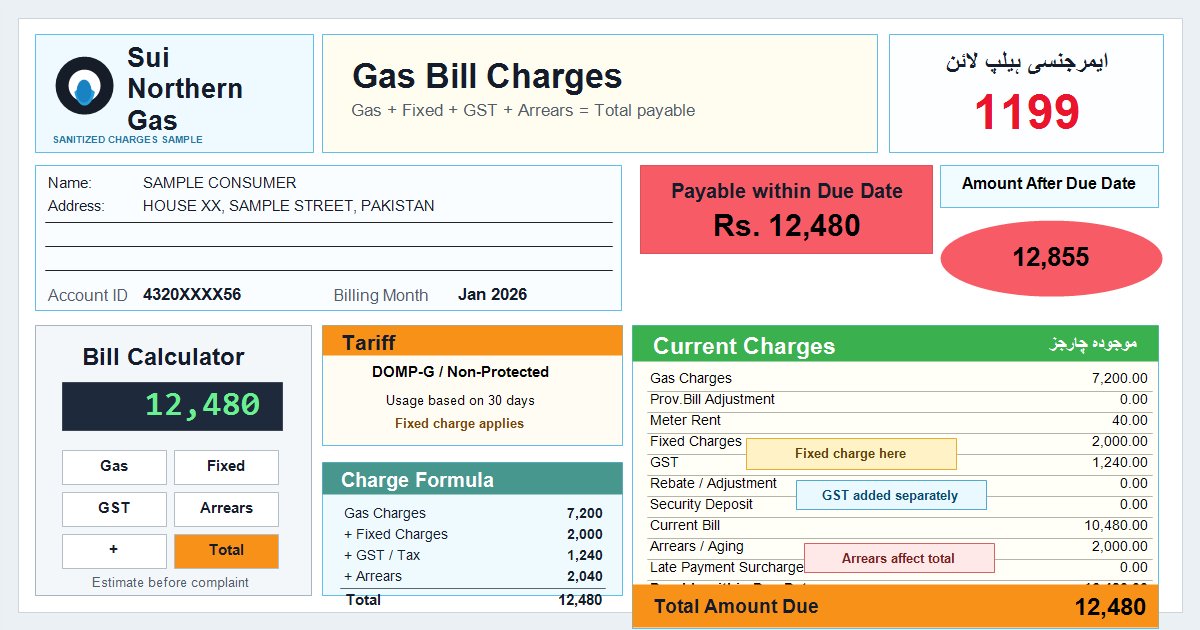
A lot of people open their SNGPL or SSGC bill and the first reaction is the same: "Gas to itni use hi nahi hui, bill itna zyada kahan se aa gaya?" In many cases, the answer is not one hidden charge. It is the mix of gas charges, fixed charge, meter rent, GST, arrears, late surcharge, and sometimes adjustment or security deposit.
This guide explains the common lines you may see on a Pakistani Sui gas bill, in simple words, so you can check whether the amount makes sense before calling the helpline or visiting an office.
Source check
Last checked: June 7, 2026. This explainer was checked against visible SNGPL/SSGC bill labels, OGRA consumer gas price pages, SSGC billing FAQs, SSGC gas-rate pages, and SNGPL tariff references. Your latest official bill remains the final source for the payable amount.
Quick Answer
Your Sui Gas bill is not simply meter reading x gas rate. A normal domestic bill can include:
- Gas charges for the gas consumed in the billing month.
- Fixed charges based on protected or non-protected category.
- Meter rent for the gas meter installed at your premises.
- GST and other applicable taxes calculated by the billing system.
- Arrears or previous balance if an older amount is unpaid or carried forward.
- Late payment surcharge if payment is made after the due date.
- Adjustment, rebate, GSD, or security deposit in specific cases.
So if the current usage looks low but the total bill is still high, check the fixed charge, arrears, tax, and payment-after-due-date lines before assuming the meter reading is wrong.
Bill Charges at a Glance
The exact wording can be slightly different on SNGPL and SSGC bills, but these are the common lines most domestic users should understand.
| Bill line | Simple meaning | What to check |
|---|---|---|
| Gas Charges | Amount for gas consumed in the billing period. | Compare current and previous meter readings. |
| Fixed Charges | Monthly category-based charge, not directly tied to this month's usage. | Check protected or non-protected status. |
| Meter Rent | Recurring charge for the gas meter. | Confirm meter type if the amount looks unusual. |
| GST / General Sales Tax | Tax applied according to official billing rules. | Check whether tax increased because charges increased. |
| Arrears / Aging / Previous Balance | Older unpaid or carried-forward amount. | Match it with your last bill and payment receipt. |
| Late Payment Surcharge | Extra amount after missing the due date. | Compare payable within due date vs after due date. |
| Rebate / Adjustment | Correction, credit, or debit from a previous bill. | Look for meter correction, provisional bill, or complaint adjustment. |
| Security Deposit / GSD | Gas Supply Deposit or security amount maintained with the company. | Check whether it is a normal deposit recovery or an additional demand. |
| Total Amount Due | Final payable amount after adding current charges, tax, arrears, and surcharge if any. | This is the amount to confirm before payment. |
Gas Charges
Gas Charges are the usage-based part of the bill. This starts from your meter reading. The company records how much gas was consumed, then the billing system converts volume into the billing unit used for tariff calculation, usually involving GCV, pressure correction, and MMBTU.
On SSGC's official FAQ, the company explains that gas bills are computed at the prevailing OGRA-notified tariff for the customer category, along with meter rent and applicable taxes. It also explains GCV, BTU/MMBTU, and pressure correction factor. In normal words: the bill is not just one simple unit rate like a mobile package. There is a calculation behind it.
Pakistani household tip
If your gas charges look wrong, first compare the current reading and previous reading printed on the bill. Then take a clear photo of the physical meter before making a complaint. A blurry meter photo usually wastes time.
Fixed Charges
Fixed charge is the line that surprises many people. It can appear even when you used very little gas. That is why someone may say, "Geyser band tha, phir bhi bill aa gaya." The fixed charge is usually linked with your tariff category, especially protected or non-protected status.
As the site's current tariff guides explain, a protected domestic consumer may see a lower fixed charge, while a non-protected consumer can see a much higher fixed charge. On many 2026 domestic bills, this is why the payable amount can remain high even during summer.
Protected consumer
Usually lower fixed charge and lower slab impact. Category depends on winter-average usage rules, not only today's reading.
Non-protected consumer
Higher fixed charge and higher bill pressure. Low summer usage does not always remove the non-protected charge.
If the fixed charge is the main reason your bill is high, read the protected vs non-protected guide and then compare it with your latest official bill.
Meter Rent and GST
Meter Rent is a regular charge for the meter installed at your premises. SSGC's official FAQ says that for normal domestic meters, monthly meter rent is charged, and the amount can vary for other meter types according to approved fixed and variable charges.
GST or General Sales Tax is the tax part of the bill. If your gas charges, fixed charge, or other bill components increase, GST can also look higher. This is why two users with similar current usage can still have different final amounts if their category, arrears, or adjustments are different.
Some SSGC bills may also show lines such as WHT, Extra Tax, Further Tax, or CNIC/NTN-related notices. Not every domestic household will see every line every month. If you see a tax line you do not understand, check whether your CNIC/NTN information is updated and confirm with the official company channel.
Arrears, Previous Balance, and Late Payment Surcharge
Arrears, Aging, or Previous Balance usually means an older amount has been carried forward. This can happen when:
- A previous bill was unpaid or partly paid.
- Payment was made close to the due date but did not update in time.
- An installment or adjustment was added to the account.
- A provisional or estimated bill was later corrected.
Late Payment Surcharge is different. It is the extra amount charged when the bill is paid after the due date. SSGC's FAQ states that for domestic customers, LPS is applied in case of default. Your bill usually makes this easy to see by showing Payable Within Due Date and Payable After Due Date.
Before saying "bill double ho gaya"
Check whether the amount you are looking at is within due date or after due date. Many people compare last month's within-due-date amount with this month's after-due-date amount and think the gas company increased the rate.
Security Deposit, GSD, Rebate, and Adjustments
Security Deposit or GSD means Gas Supply Deposit. SSGC's FAQ explains that GSD is maintained against each customer and can be reviewed according to average consumption. If the required deposit changes, a recovery or adjustment can appear.
Rebate / Adjustment can be good or bad depending on the case. It may be a credit because you were overcharged earlier, or a debit because the company corrected a previous bill. Common reasons include:
- Estimated or provisional bill later replaced with actual reading.
- Meter reading correction after complaint.
- Security deposit update.
- Old unpaid amount shifted into current bill.
- Meter replacement, PUG, slow meter, or other technical adjustment.
If the adjustment is large, do not guess. Keep the current bill, last two bills, payment receipts, and meter photo, then contact the relevant office or helpline.
Why the Bill Feels High Even When Usage Is Low
In Pakistani homes, the most common confusion is this: the family uses less gas in summer, but the bill does not fall as much as expected. Usually one of these things is happening:
| Situation | Likely reason | Next step |
|---|---|---|
| Low usage but high amount | Fixed charge, GST, or non-protected category | Check category and fixed charge line |
| Bill suddenly jumped | Estimated, combined, or corrected reading | Compare current/previous meter readings |
| Amount includes old balance | Arrears, previous balance, or late payment | Match with receipt and payment date |
| Extra deposit or adjustment | GSD/security deposit or bill correction | Ask for account-level explanation |
For a rough estimate before the official bill arrives, use the Sui Gas bill calculator. It is not a replacement for the official amount, but it helps you understand whether the current reading roughly matches the bill direction.
What to Check Before Complaining
Before calling 1199 or going to a Customer Facilitation Center, prepare these things. It makes the complaint much easier to explain.
- Company: SNGPL or SSGC.
- Consumer number / Account ID / Customer Number: Copy it exactly from the bill.
- Billing month: Make sure you are not looking at an older bill.
- Current and previous reading: Compare both with your physical meter.
- Category: Protected or non-protected, if shown.
- Fixed charge: Check if this is the main reason for the high bill.
- Arrears or previous balance: Match with your last receipt.
- Late surcharge: Confirm whether you paid before or after the due date.
- Adjustment or security deposit: Note the exact line name printed on the bill.
Simple rule
If the meter reading is correct but the bill is high, look at fixed charge, GST, arrears, and adjustment. If the reading itself looks wrong, take a meter photo and file a reading-related complaint.
Official References
Useful source links
- OGRA Consumer Gas Prices - official consumer gas price notifications and historical gas sale price notices.
- SSGC Frequently Asked Questions - billing basis, provisional bills, GCV, meter rent, LPS, GSD, and payment questions.
- SSGC Gas Rates - domestic, commercial, and industrial rate pages.
- SNGPL Tariff Definition - official SNGPL tariff-category reference.
- SNGPL Consumer Gas Prices - SNGPL consumer gas price reference page.
Related reading
Protected vs Non-Protected Consumers
Understand why category status affects fixed charge and overall gas bill amount.
Why Gas Bills Stay High in Summer
See why low current usage does not always mean a very low bill.
Sui Gas Bill Calculator
Estimate your bill from current and previous meter readings before comparing it with the official bill.
How to Pay Sui Gas Bill Online
Pay through JazzCash, Easypaisa, banking apps, and keep proper receipt proof.
Frequently Asked Questions
Why is my Sui Gas bill high even with low usage?+
A gas bill can stay high because of fixed charge, GST, meter rent, arrears, previous balance, late surcharge, non-protected category, or an adjustment. Check these lines before assuming the meter reading is wrong.
What are fixed charges in SNGPL and SSGC bills?+
Fixed charges are monthly category-based charges. They are not removed just because current usage is low. Protected consumers usually see lower fixed charges than non-protected consumers.
What is arrears or aging on a gas bill?+
Arrears or aging usually means an unpaid older amount or a balance carried forward. It can also appear after a correction, adjustment, or payment update delay.
What is late payment surcharge?+
Late payment surcharge is the extra amount applied when a gas bill is not paid by the due date. Always compare payable within due date and payable after due date on the bill.
What is GSD or security deposit?+
GSD means Gas Supply Deposit. It is a security amount maintained with the gas company. If your average bill changes or the company updates your required deposit, a GSD or security deposit adjustment may appear.
Shahzaib Qureshi
Shahzaib Qureshi is the public editorial name for SuiGas.com.pk. The site publishes practical, source-backed guides to help Pakistani consumers understand SNGPL and SSGC bills, tariff changes, duplicate bill access, payment options, and common billing issues. SuiGas.com.pk is independent and is not affiliated with SNGPL, SSGC, OGRA, or any government department.