How to Read Your SNGPL or SSGC Gas Bill
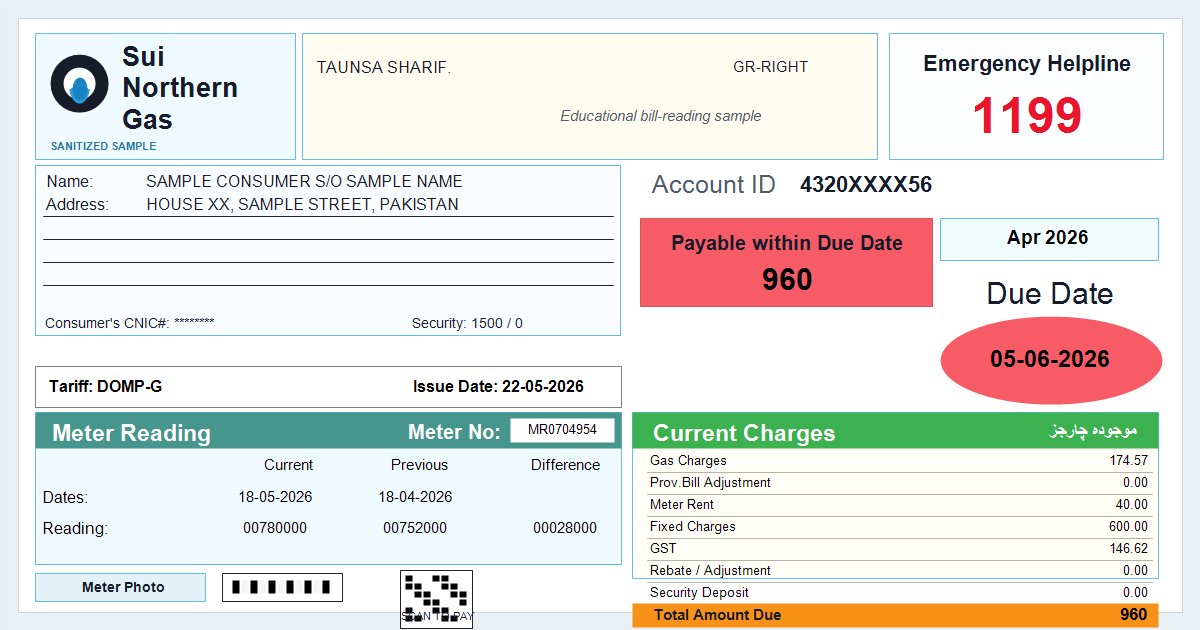
A Sui gas bill looks simple until you actually try to understand it. One side has consumer number, meter details, bill month, due date, readings, arrears, taxes, and total amount. The other side may have tariff notes, payment slip, or extra instructions. For a normal Pakistani household, it can feel like half bill, half puzzle.
This guide explains how to read the main parts of an SNGPL or SSGC bill without getting lost. Once you know where each field is, it becomes easier to check your duplicate bill, compare the meter reading, understand why the payable amount is high, and file a proper complaint if something looks wrong.
Source check
Last checked: June 8, 2026. This guide uses visible SNGPL/SSGC bill layouts, OGRA consumer gas price references, SSGC billing FAQs, SSGC gas-rate pages, and SNGPL tariff references. Your latest official bill remains the final source for account-specific amounts.
Quick Answer
If you only have two minutes, read the gas bill in this order:
- Confirm the consumer number, customer number, or account ID belongs to your house.
- Check the billing month, issue date, and due date.
- Compare current reading, previous reading, and consumption.
- Check tariff category and protected/non-protected status if shown.
- Read gas charges, fixed charge, meter rent, GST, and other taxes.
- Look for arrears, adjustments, rebate, or late payment surcharge.
- Finally, check total amount due and the amount after due date.
Do not judge the bill only from the big payable amount. First see what is making it high: current usage, fixed charges, arrears, GST, correction, or late payment.
Account Details: Consumer Number, Customer Number, and Meter Number
The first job is confirming that the bill is actually yours. This sounds obvious, but meter mix-ups, old bills, tenant bills, and saved duplicate-bill screenshots can create confusion.
| Field | What it means | Why it matters |
|---|---|---|
| Consumer Number | Main SNGPL-style account identifier used for duplicate bill and complaints. | A wrong digit can open someone else's bill or fail complaint tracking. |
| Customer Number / Account ID | SSGC-style customer identifier depending on bill format. | Needed for bill lookup, complaints, and customer service follow-up. |
| Meter Number | Number printed for the gas meter installed at your premises. | Useful when reporting meter mix-up, damaged meter, or wrong reading. |
| Name and Address | Registered consumer details and service address. | Helpful for tenants, landlords, and complaint location verification. |
If you use our bill pages, enter the number exactly as printed on your official bill: SNGPL bill check for SNGPL users and SSGC bill check for SSGC users.
Billing Month, Issue Date, and Due Date
The billing month tells you which month's usage is being billed. The issue date tells you when the bill was generated. The due date is the last date to pay without late payment surcharge.
- Billing month: Use this to compare with your gas usage pattern. Winter months usually show higher cooking/heating usage.
- Issue date: Useful when checking whether the bill is fresh or an old screenshot.
- Due date: Pay before this date to avoid late payment surcharge.
- Amount after due date: This may include LPS or surcharge, so do not confuse it with the normal payable amount.
Small but common mistake
Many people check an old downloaded bill from WhatsApp or gallery and pay late. Always confirm the billing month and due date before paying.
Meter Reading Section: Current, Previous, and Consumption
The meter reading section is the heart of the bill. It tells you how much gas the company has counted for the billing cycle.
Reading fields
- Previous reading: Meter reading from the last billing cycle.
- Current reading: Latest reading used for this bill.
- Difference or consumption: Current reading minus previous reading.
- Reading date: The date when reading was recorded, if shown.
How to check
- Go to your physical gas meter.
- Read the main black digits carefully.
- Compare with the bill's current reading.
- Take a clear photo if the bill reading looks wrong.
The physical meter reading today should normally be equal to or higher than the bill's current reading, because you may have used gas after the company recorded the reading. If the bill reading is much higher than the physical meter even today, that is a red flag.
If the bill appears estimated or the reading looks wrong, read our dedicated guide: estimated gas bill or wrong meter reading.
Tariff Category and Protected / Non-Protected Status
Your tariff category decides how your gas usage is priced. Domestic, commercial, industrial, and special categories are not billed the same way. For households, protected/non-protected status can also affect the final bill.
SNGPL publishes tariff category references, SSGC publishes gas-rate pages, and OGRA publishes consumer gas price notices. In simple words, tariff is not just a random company choice on your bill. It is tied to official category and price structures.
Where users get confused
A low number of units does not always mean a low bill. Fixed charges, minimum charges, protected/non-protected status, previous arrears, and taxes can still make the final payable amount higher.
For the 0.9 hm3 protected-status rule and why winter usage matters, see our protected vs non-protected consumers guide.
Charges Section: Gas Charges, Fixed Charge, Meter Rent, GST
The charges section explains how the payable amount is built. On many bills, the number that scares people is not only gas usage. It can include multiple lines.
| Bill line | Plain meaning |
|---|---|
| Gas Charges | Usage-based amount calculated from consumption and tariff category. |
| Fixed Charge / Minimum Charge | A fixed amount that may apply even when usage is low. |
| Meter Rent | Monthly meter-related charge if applicable. |
| GST / Taxes | Applicable tax lines added to the bill. |
| Late Payment Surcharge | Extra amount if the previous bill was paid after due date or unpaid. |
SSGC's billing FAQ explains that bills are computed at the prevailing OGRA-notified tariff for the customer category, along with meter rent and applicable taxes. It also discusses terms like GCV, BTU/MMBTU, pressure correction factor, LPS, and security deposit. That is why a gas bill is more than one simple unit-rate calculation.
For a deeper line-by-line explanation, use our Sui gas bill charges explained guide.
Arrears, Adjustments, Rebate, and Previous Balance
Arrears are one of the biggest reasons people say "maine gas kam use ki, bill phir bhi zyada aa gaya." Sometimes the current usage is not the main issue. The bill may be carrying an older amount.
- Arrears: Unpaid or carried-forward amount from an earlier bill.
- Adjustment: Correction, rebate, or added amount due to a previous billing issue.
- Previous balance: Old balance brought into the new bill.
- Security deposit adjustment: Deposit-related amount if applied by the company.
- Late surcharge: Penalty due to late payment.
Before complaining, compare the last two or three bills. Also check whether your last payment was made before due date and whether the payment was updated. If payment was deducted but not reflected, see our online payment guide.
Total Amount Due and Payment Slip
The total amount due is the actual amount you need to pay before the due date. Some bills also show an amount payable after due date. Do not mix these two.
Practical rule
If you are paying before the due date, use the normal total amount due. If the due date has passed, check the after-due-date amount or confirm through the official bill/payment channel.
The payment slip or barcode area helps banks, mobile wallets, and payment apps identify the bill. If you pay through JazzCash, Easypaisa, bank app, ATM, or counter, save the receipt until the next bill shows the payment correctly.
SNGPL vs SSGC Bill Layout: Why It Looks Different
SNGPL and SSGC bills do not always use the same labels or layout. SNGPL users often search by consumer number. SSGC users may see customer number, account ID, meter number, customer type, and billing sections in a different order.
Do not panic if your bill does not match a screenshot exactly. Focus on the purpose of each field:
- Account identifier: consumer number, customer number, or account ID.
- Billing period: billing month, issue date, and due date.
- Meter usage: previous reading, current reading, difference, and units.
- Charges: current charges, taxes, rent, fixed/minimum charge.
- Old amounts: arrears, adjustments, previous balance, surcharge.
- Payment: total amount due and after-due-date amount.
Common Mistakes to Check Before Paying
Before paying or filing a complaint, do this quick check. It catches many ordinary problems.
- Is the consumer/customer number correct?
- Is the bill month current, or are you looking at an old bill?
- Is the due date still valid?
- Does the current reading make sense compared with your physical meter?
- Did arrears or late surcharge come from an older unpaid bill?
- Was the last payment deducted but not updated?
- Did an estimated/provisional bill later get adjusted?
- Is the protected/non-protected status causing fixed charges?
If you find a real issue, file a complaint with proof instead of only saying the bill is high. Our SNGPL and SSGC complaint online guide explains how to register, track, and follow up.
Official References
Useful source links
- OGRA Consumer Gas Prices - official consumer gas price notifications and historical gas sale price notices.
- SSGC Frequently Asked Questions - billing basis, provisional bills, GCV, meter rent, LPS, GSD, and payment questions.
- SSGC Gas Rates - domestic, commercial, and industrial rate pages.
- SNGPL Tariff Definition - official SNGPL tariff-category reference.
- SNGPL Consumer Gas Prices - SNGPL consumer gas price reference page.
Related reading
Sui Gas Bill Charges Explained
Understand fixed charge, GST, arrears, meter rent, and total amount due.
Estimated Bill or Wrong Reading
Compare the bill reading with your physical meter and collect proof.
Sui Gas Complaint Online
Register, track, and follow up on SNGPL or SSGC complaints.
Sui Gas Bill Calculator
Estimate charges from readings before comparing with the official bill.
Frequently Asked Questions
Where is the consumer number on a SNGPL or SSGC bill?+
On SNGPL bills, the consumer number is usually near the top of the bill. On SSGC bills, you may need the customer number or account ID depending on the bill format. Use the exact number printed on the official bill.
How do I check meter reading on a gas bill?+
Look for current reading, previous reading, and consumption or difference. Compare the current reading with your physical meter. If the bill reading is much higher than the meter, take a clear photo and file a complaint.
What does arrears mean on a gas bill?+
Arrears usually means a previous unpaid amount, late payment amount, adjustment, or carried-forward balance. Check older bills and payment receipts before assuming it is a new usage charge.
Why is total amount due higher than gas charges?+
Total amount due can include gas charges, fixed charge, meter rent, GST, other taxes, arrears, adjustments, and late payment surcharge. The gas charges line is only one part of the final bill.
Should I pay the bill if I think the reading is wrong?+
First compare the physical meter with the bill reading and file a complaint with proof. If the due date is near, confirm through the official company channel before delaying payment, because late surcharge or arrears can create another issue.
Shahzaib Qureshi
Shahzaib Qureshi is the public editorial name for SuiGas.com.pk. The site publishes practical, source-backed guides to help Pakistani consumers understand SNGPL and SSGC bills, tariff changes, duplicate bill access, payment options, and common billing issues. SuiGas.com.pk is independent and is not affiliated with SNGPL, SSGC, OGRA, or any government department.